
Santa Cruz community sounds off against proposed
housing project at Catalyst Club site
Article From The Santa Cruz Sentinel, January 30, 2026
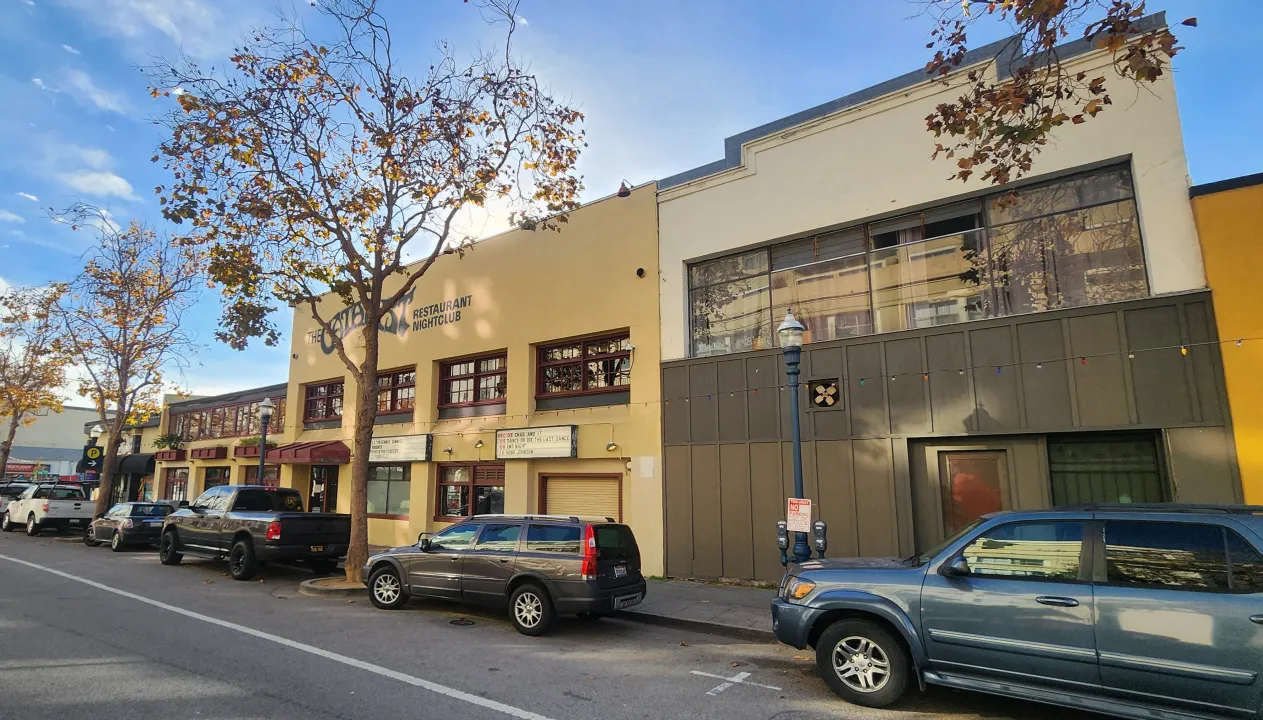
SANTA CRUZ — The effort knock to down Santa Cruz’s iconic Catalyst Club and replace it with an approximately 80-foot-tall mixed-use housing complex faced strong opposition from local residents and businesses at an informational meeting Thursday, despite attempts by the developer to assuage the community’s concerns.
“The downtown experience is unique because of the quirkiness of our streets, instead of bland white, square high rises when you walk down Pacific Avenue,” said local artist and business owner at The Vision Sanctuary gallery in downtown Santa Cruz, Rachel Corvese.
The two-hour meeting hosted by the city of Santa Cruz on Zoom attracted at least 145 attendees eager to voice their concerns and to hear additional project details since the plans were released late last year. The event began with a brief overview from city planners and a synopsis of the project from developer GSH Ventures, before it concluded with an hourlong Q&A period in which nearly all commenters expressed opposition.
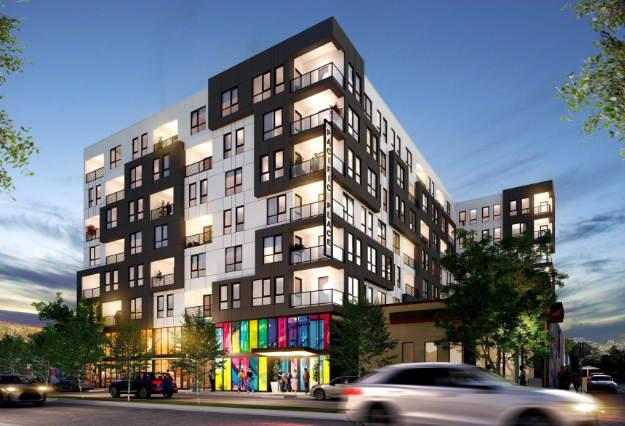
A rendering of the seven-story mixed use building proposed for the 1000 block of Pacific Avenue in downtown Santa Cruz. (Credit Humphreys and Partners Architects)
Local educator and activist Hector Marin started a Change.org petition a month ago opposing the Catalyst’s demolition and, as of Friday, the petition had collected more than 10,400 signatures.
“Yes, we do need housing. The issue of affordability is a great issue that needs to be resolved within the city,” said Marin. “But demolishing the Catalyst ain’t it.”
The project proposes to demolish nonresidential buildings and residential units at 1009, 1011 and 1015 Pacific Ave. in order to combine the three lots into one and construct a seven-story structure with 64 residential condominiums. Project leaders said at the meeting that the project will not be 100% affordable and the percentage of affordable units is yet to be determined.
While floors two and above will be used for housing, GSH representative Peter Given repeated several times that his organization intends to reconstruct the bottom floor into 15,000 square feet of commercial space that features a music club for the Catalyst, along with additional retail uses.
Still, Given later clarified that it was far too early in development process to guarantee this outcome.
“We are certainly intending … to try and have a music venue there and certainly have no interest in it being anybody other than the Catalyst,” said Given. “There’s a lot to coordinate and pull together to make that viable. But we are endeavoring to do so.”
Given and his team received support from Igor Gavric, the Catalyst’s longtime general manager and employee of 20 years. Gavric said the building itself is rapidly aging and, since it was not originally constructed as a music stage, this development could present an opportunity to reemerge with better acoustics and other improved musical features.
“I’m just a steward for a cultural institution in Santa Cruz,” said Gavric. “Where it is now is (at) an inflection point. We can’t sustain that in its current capacity much longer. This is a proposal that gives the Catalyst a future so that generations of future youth and adults can enjoy everything that we’ve offered for the past 50-plus years, for the next 50 years.”
The building at 1011 Pacific Ave. was built in 1938 as a bowling alley, but was later converted into an entertainment venue. The Catalyst has called the building home since 1976, when it moved a few blocks down from its previous location now inhabited by Bookshop Santa Cruz. Since the move 50 years ago, the club has consistently attracted some of the country’s most famous artists and bands including Chuck Berry, the Beach Boys, the Ramones, Snoop Dogg, Tom Petty, Pearl Jam, Nirvana, Green Day and Neil Young, among many others.
As residents and frequenters of the Catalyst spoke out against the proposed project, a few common themes emerged. In addition to a general desire to preserve a foundational cultural institution, many speakers questioned the viability of a project that placed a loud and active music venue beneath dozens of living spaces. Others speculated that the project violated state or local building codes, while a majority expressed a general dismay that the character of downtown Santa Cruz was irrevocably changing as high-rise apartments continue to pop up.
Rina Zhou, the planner at the city of Santa Cruz responsible for reviewing the project, said state laws in recent years — specifically Senate Bill 330 and the Housing Accountability Act — have strongly incentivized housing construction while limiting local control. As long as a proposal meets the city’s objective standards, developers can include density bonuses that make the project eligible to request waivers and concessions that the city cannot deny. Zhou also clarified that the Catalyst is outside of the state’s coastal zone and is not subject to oversight by the California Coastal Commission.
The city has also received a number of inquires about designating the building as a California Historical Landmark, but Zhou said it’s too late for that. In order for historic status provisions to apply, a building must have achieved that status prior to completion of a preapplication. Zhou said this project’s preapplication was deemed complete Dec. 19, 2025, with the developer indicating an intention to use a statutory exemption under the California Environmental Quality Act. Because the building has no such historic designation, any subsequent achievement of that status will not apply to the project.
Furthermore, if that status is eventually achieved and the housing project falls through, it could create a series of challenges for future Catalyst owners to complete renovations.
Alyssa Pullen, one of the owners of the Tea House Spa next door, shared concerns about how the construction effort will impact the viability of neighboring businesses. Pullen explained that the spa shares 40 linear feet of wall space with the Catalyst and said demolition of the building will expose private tub areas.
“How will the city ensure that longstanding businesses like the Tea House Spa will not face forced closure because of their shared walls with the Catalyst?” said Pullen. “The Tea House Space has been in downtown Santa Cruz for 40 years and currently employs 60 employees.”
Given and city staff offered to meet with Pullen to further discuss the issues.
“We are in the design phase and are seeking feedback in ways that we can apply to this project to make it functional for everybody,” said Given. “So if there’s privacy concerns and elements like that that we can reasonably address through design and implementation, we welcome the opportunity to talk about it.”
Jesse Cummings, owner of Old School Shoes at 1017 Pacific Ave., said it has been a rough few years for locally owned businesses in downtown Santa Cruz and asked about the development timeline.
“Since the pandemic, (it) has been insanely hard and to have all of the construction projects that have eliminated so much parking around us, not to mention closed-off sidewalks (and) loud machinery,” said Cummings. “I cannot imagine us being able to survive you guys constructing this big thing that literally surrounds and will, like, block out the sunlight.”
Given, after also offering to meet with Cummings and his landlord, said his team is operating with thin margins and is trying to move quickly. He indicated the design and permitting process could take the remainder of 2026 and said GSH estimated a “24-month project.” It wasn’t immediately clear if that meant 24 months from now or from when all project documents are complete.
Many public attendees shared serious doubts that a music venue and living facility could coexist in the same building, but Given assured the audience that GSH was working with engineers to try to make it happen.
“There are music venues that have residential units above them throughout the country and elsewhere,” said Given. “It’s not easy. … It’s very complicated and we are early in the process and we are doing our best to find a way to make it work and hopefully we can.”
Given said he has tentatively set up open house and design update sessions from 9:30-11:30 a.m. at the Catalyst on Feb. 25 and March 25. Project updates will continue to get posted online at santacruzca.gov/significantprojects.